Finishing your basement is an incredible way to expand your home’s usable footprint. But whether you are building a booming home theater, a quiet executive office, or a legal basement ADU for a tenant, there is one crucial element that homeowners frequently overlook until it is too late: Soundproofing.
Without proper acoustic insulation, a finished basement can quickly become an echo chamber. Every footstep on the hardwood floors upstairs will reverberate through the basement ceiling like a drum, and the bass from the downstairs TV will rattle the master bedroom two floors up.
Once the drywall is taped, painted, and finished, retroactively adding soundproofing is nearly impossible without tearing the space apart. At Jazz Construction Group, we strongly advise clients to factor acoustic treatments into their initial basement renovations cost. Here is the science behind how we build truly quiet, isolated lower levels.
The Two Types of Noise: Airborne vs. Impact
To effectively soundproof a basement, you must understand what you are fighting against. Sound travels in waves, and in a residential home, it takes two distinct forms:
- Airborne Noise: This is sound that travels through the air before hitting a barrier. Examples include voices, music, barking dogs, and television dialogue.
- Impact (Structure-Borne) Noise: This is physical vibration transmitted directly through the building materials. The most common example is the thud of heavy footsteps, moving chairs, or dropping a toy on the floor directly above the basement.
Standard fiberglass insulation might muffle a few voices, but it does absolutely nothing to stop impact noise. To stop both, we have to employ the “Holy Trinity” of soundproofing: Absorption, Mass, and Decoupling.
1. Absorption: Acoustic Insulation
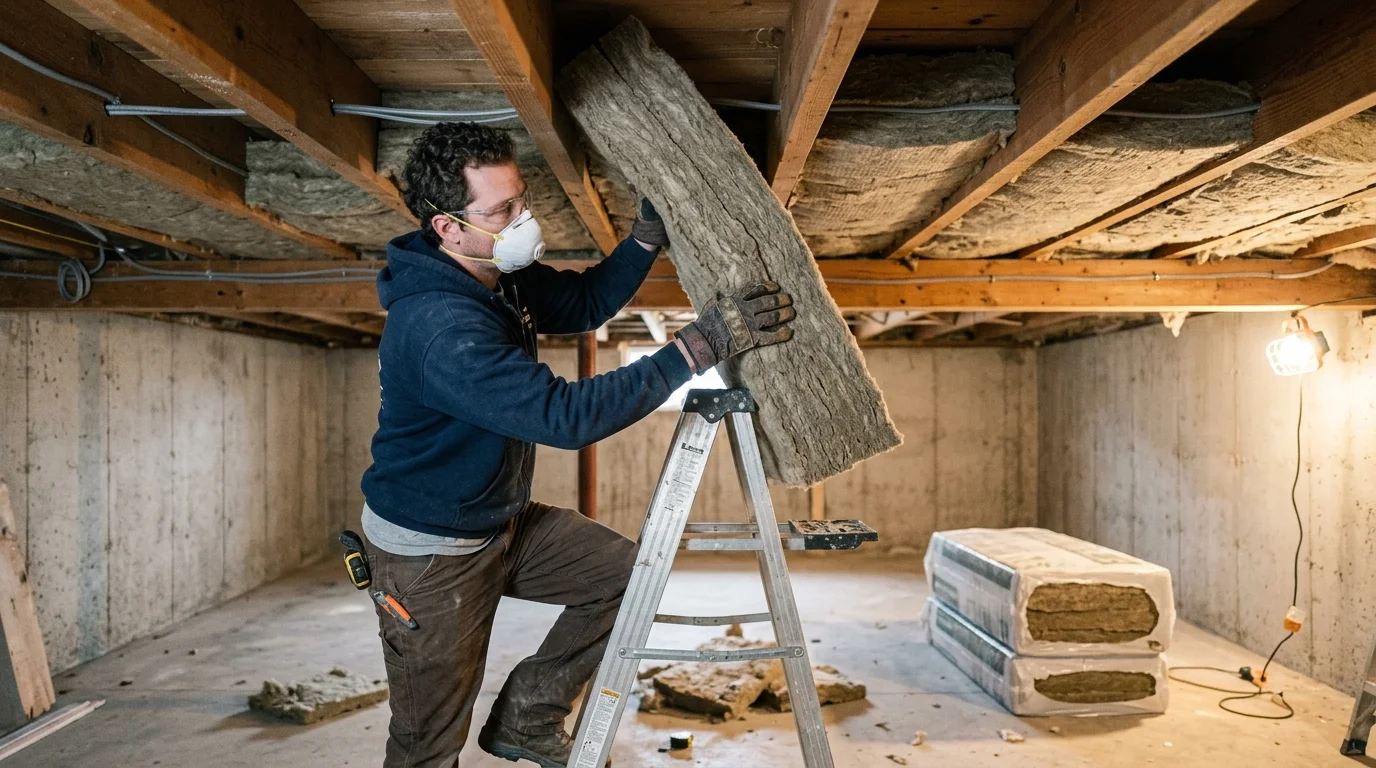
The first step in soundproofing the basement ceiling is filling the empty cavities between the wooden floor joists. An empty joist cavity acts exactly like the body of an acoustic guitar—it amplifies sound.
The Rockwool Advantage
We do not use standard pink fiberglass insulation for soundproofing. Instead, we use mineral wool (often referred to by the brand name Rockwool). Mineral wool is incredibly dense and heavy, designed specifically to absorb and scatter airborne sound waves before they can bounce between the upper floor and the basement ceiling. As a bonus, mineral wool is also highly fire-resistant.
2. Mass: Blocking the Sound Waves
Sound waves are physical energy. To stop them, you have to put a heavy, dense object in their way. Standard 1/2-inch drywall is too light and flexible to stop serious noise.
To increase the mass of the ceiling, we employ two tactics:
- 5/8″ Fire-Code Drywall: We use thicker, denser drywall for the basement ceiling. The added weight makes it significantly harder for sound waves to vibrate the boards.
- Mass Loaded Vinyl (MLV): For premium home theaters or rental apartments, we can install a layer of MLV—a heavy, flexible, rubber-like mat—directly against the joists before the drywall goes up. It acts as a massive, deadening roadblock for sound.
3. Decoupling: The Secret to Stopping Footsteps
If you want to stop impact noise (footsteps), you must physically separate the basement ceiling from the floor upstairs. If the drywall is screwed directly into the wooden joists, every footstep upstairs will vibrate through the wood and directly into the drywall.
Resilient Channels and Whisper Clips
Decoupling is the process of breaking that physical connection. Instead of screwing the drywall into the wood, we install metal “resilient channels” across the joists using specialized acoustic isolation clips (often called whisper clips). These clips feature rubber grommets that absorb vibration. The drywall is then attached to the metal channels. Because the drywall is no longer touching the wood, the vibrations from footsteps are completely isolated and absorbed before they reach the basement.
Soundproofing Materials at a Glance
| Material/Technique | Primary Function | Target Noise Type |
|---|---|---|
| Mineral Wool (Rockwool) | Absorbs sound bouncing inside the ceiling cavity. | Airborne Noise (Voices/TV) |
| 5/8″ Drywall & Green Glue | Adds heavy mass and deadens vibration. | Airborne & Mild Impact Noise |
| Resilient Channels & Clips | Decouples the ceiling from the floor joists. | Heavy Impact Noise (Footsteps) |
| Solid Core Doors | Prevents sound from leaking out of the basement stairwell. | Airborne Noise |
Frequently Asked Questions
Will a drop ceiling soundproof my basement?
Traditional acoustic drop ceilings (suspended tiles) are excellent at reducing echo within the basement itself, making the room sound better. However, they are generally terrible at preventing sound from traveling to the floor above unless they are paired with heavy insulation above the grid.
Is soundproofing required for a legal basement apartment?
Many New Jersey municipalities mandate a specific STC (Sound Transmission Class) rating between separate dwelling units. If you are building a legal ADU, proper acoustic separation between the basement and the main floor is often a strict fire and building code requirement.
What is “Green Glue”?
Green Glue is a specialized acoustic dampening compound. For extreme soundproofing (like a home recording studio), we install two layers of drywall on the ceiling and sandwich a layer of Green Glue between them. The glue converts sound vibrations into tiny amounts of heat, killing the noise instantly.
Build a Space for Peace and Quiet
A true luxury basement feels solid, serene, and perfectly isolated. Don’t let cut corners turn your new space into an echo chamber. Partner with Jazz Construction Group to engineer a lower level that looks stunning and sounds perfectly silent. Explore our basement renovation services today.
Get a Free Renovation Estimate