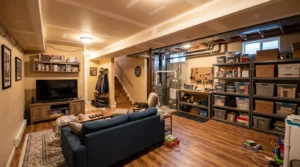
There is no better place in a home to build a dedicated media room than the lower level. Basements are naturally dark, naturally insulated by the surrounding earth, and separate from the primary sleeping and living areas upstairs. It is the perfect blank canvas for a cinematic experience.
However, bringing the magic of the movies into your home requires more than just mounting a big TV and buying a comfortable couch. A true basement home theater requires careful planning of sound travel, specialized wiring, and intentional layout.
At Jazz Construction Group, we specialize in high-end basement renovation projects that look and sound incredible. Here is the ultimate guide to mastering acoustics, wiring, and seating for your new home theater.

1. Soundproofing vs. Acoustics: Getting the Audio Right
When designing a media room, you are fighting two different audio battles. Soundproofing keeps the noise of an action movie from waking up your kids upstairs. Acoustics manages how the sound bounces around inside the room itself.
Soundproofing (Stopping Sound Transfer)
If you want to crank up the subwoofer, you must address the ceiling and walls before the drywall goes up.
- Insulation: Standard fiberglass won’t cut it. We recommend using dense mineral wool (like Roxul Safe’n’Sound) in the ceiling joists and wall cavities.
- Resilient Channels: Instead of screwing drywall directly to the ceiling joists, we install metal tracks (resilient channels). This “decouples” the ceiling, breaking the path of sound vibrations.
- Double Drywall & Green Glue: For extreme soundproofing, hanging two layers of 5/8″ drywall with a specialized acoustic compound (Green Glue) sandwiched between them absorbs low-frequency bass.
Acoustic Treatment (Improving Sound Quality)
Basements are full of hard surfaces (concrete floors, drywall) that cause sound to echo. To get crisp dialogue and tight bass, you need to absorb those reflections.
- Flooring: Always choose thick carpet with a dense underpad for a home theater. It is the largest acoustic absorber in the room.
- Acoustic Panels: Hang fabric-wrapped acoustic panels at the “first reflection points” on your side walls to stop sound waves from bouncing directly into your ears.
2. Pre-Wiring: The Invisible Magic
The biggest mistake DIYers make is finishing their drywall before running their audio-video (A/V) cables. Once the walls are closed, hiding wires becomes a costly nightmare.
During the framing stage of your basement renovation, plan for the following:
| Cable Type | Where to Run It | Purpose |
|---|---|---|
| High-Speed HDMI (Fiber Optic) | From A/V receiver to projector or TV location. | Carries 4K/8K video signals. *Run two just in case one fails!* |
| 14-Gauge Speaker Wire | To all surround sound speaker locations (e.g., 5.1, 7.1, or Dolby Atmos ceiling speakers). | Powers passive speakers from your receiver. |
| Subwoofer Coaxial (RCA) | To front corners or rear of the room. | Delivers the low-frequency effects channel. |
| Cat6 Ethernet | To A/V receiver, Apple TV/Roku, and projector. | Hardwired internet prevents buffering during 4K streaming. |
3. Seating and Layout: The Perfect View
If you want the true cinema experience, you need multiple rows of seating. But if you put two rows of couches on a flat floor, the people in the back will only see the back of the heads in front of them.
- Building a Riser: We construct wooden seating platforms (risers) for the second row. A standard riser is about 7 to 12 inches tall, depending on your ceiling height and screen size. We recommend filling the cavity of the riser with insulation so it doesn’t act like a giant drum when the bass hits.
- Viewing Distance: If you install a massive 120-inch projector screen, you don’t want to sit 5 feet away. A general rule of thumb for 4K viewing is to sit at a distance equal to 1 to 1.5 times the diagonal size of the screen.

4. Lighting for the Cinematic Vibe
A theater room needs pitch darkness when the movie plays, but safe, ambient lighting before and after.
Install dimmable LED wall sconces to provide a soft wash of light without glaring onto the screen. To take it to the next level, run LED strip lighting under the lip of your seating risers or along the baseboards. This provides the classic “movie theater aisle” look and keeps people safe if they need to grab a snack in the dark.
Frequently Asked Questions
Should I choose a projector or a large TV?
If you want a screen larger than 85 inches, a 4K projector and a fixed screen offer the best value and the most authentic theater experience. However, if your room gets a lot of ambient light, an 85″ or 98″ OLED/QLED TV will provide better contrast and deeper blacks.
What is the minimum room size for a home theater?
You can create a great media space in a room as small as 10×12 feet using a TV and a soundbar. However, for a true dedicated theater with a projector, surround sound, and two rows of seating, you ideally want a space that is at least 12×18 feet.
How much does soundproofing cost?
Adding basic soundproofing (mineral wool and resilient channels) typically adds 15% to 20% to the cost of standard drywall and framing for that specific room. It is highly recommended if the theater is directly below a bedroom.
Bring the Cinema to Your Basement
Building a flawless home theater requires expert knowledge in framing, electrical wiring, and acoustics. Don’t leave your entertainment to chance. Explore our basement renovation services and let our team design the perfect media room for your home.
Get a Free Media Room Quote